September 3, 2010

Some Favorite Paper Collectibles

Pen & Ink Kitten late 19th Century
Collecting paper items has been a life-long love of mine and was and still is my first love, mainly because paper is related to reading, writing, and drawing. I used to sneak my treasures from the garbage can soon after my third birthday. I stored these in a heart shaped box, a leftover from my mother's Valentine candy. I wasn't picky back then, of course I couldn't read very well either.

To this day I have stacks and piles of books flowing from numerous book cases throughout my building; papers horded in boxes including vintage candy boxes, a gentleman's underwear box, cigar boxes, cloth boxes and other boxes that are just to kool to throw away. I have boxes of advertising, postcards, newspaper cut outs, recipes, scribbled notes, perfect penmanship, letters, store receipts, and well just about any paper item that was ever invented, made, or printed - some going as far back as the 1600s.

Gibson Girl 1912 Sketch Book
I am particularly fond of diaries and old sketch books although 19th century and earlier books of this kind are rare finds. I think that in a former life I was a scribe but most likely it was the simple fact that writing paper and writing implements were costly and scarce.

One of my favorite finds (okay - I have numerous favorites) was a tin filled with scraps of paper. Turned out the papers were from men who took "The Oath" during the Revolutionary War era. Another find was an old chest in an attic that the family considered trash.

Pen & Ink Drawing
Thankfully someone threw it in auction. There were amazing letters and documents that told of settling the coastal region of North Carolina and Tennessee. There were slave records and documents along with rare books although some were in very sad shape.  But everything is recyclable - okay - almost everything. 

Imagine history being dumped in a garbage can - which is still my life-long avocation - saving someone else's trash, and rescuing it into treasure.     

Cow Frog & Date
Brekekekex koax koax!
May the force of the frog be upon you!

September 1, 2010

Antiques in Bethania Celebrates 14 Years

I officially opened my antique shop under the name of The Bethania Emporium in 1997, but wasn't really sold on the name and also registered the name Antiques in Bethania. When the first outdoor sign I had made disintegrated after a few years, I switched over to Antiques in Bethania with the new sign, but also kept on to the other name. I decided it was time I chose one name - subsequently - Antiques in Bethania won out.

In the beginning and up until 2007, we had three apartments above the shop (oh what stories I could tell - but I won't). In 2008 and I ceased being a landlord and we converted the upstairs into our home. We knocked down walls, put in French doors, new windows, new floors, added functional space, but still must contend with a small kitchen - the work was labor intense and thank goodness my husband is a plumber. We love living here,and earlier this year we gave the front of the shop a face lift. Though we still have some work to do, such as restoring the back of the shop for my writers workshop and studio, the changes have really been an improvement.

The building was built in the late 1940's as a grocery store and apartments. Over the years it has been an antique shop, cabinetmakers shop, wicker shop, toy and hobby shop, and always apartments.

For many years people used our drive as a short cut to the back lane. The back has grass, bushes, and trees along with boulders and other landscaping. We added a deck and put up decorative criss-cross fencing that one day I hope to train vines to go up. It is private though and we can sit out doors and not feel like we are in a fish bowl. Zach and Zoie, our Yorkies in training can run and play freely - along with their friend Mr. Wiggles and his big black Lab companion who like to come and visit.

Zach
This month - September - marks the beginning of my 14th year. I think the shop has evolved in many ways, besides being a front for my writing and I love being here, even more so now because the building is also our home. I am surrounded by inspiration and can immerse myself in history on a daily basis - what more can anyone ask for?

August 31, 2010

My Historic Photographs of Bethania

are on Facebook although not authorized by me or there with my permission. Take a look at the image on the right and notice how the second child from the left is distorted. The Facebook page happens to be the one for the town of Bethania. I wouldn't mind (actually I do mind) but they are not carrying my book in their shop - claim that everything is purchased through Old Salem. It's really the feud and fences. The images are from original glass negatives in my possession and were taken by JL Kapp around the turn of the century. I paid dearly to have these glass images made into photographs.

The images are from my book also and I have some posted on both my websites. So is the information for my book, Bethania: The Village by the Black Walnut Bottom.

August 27, 2010

Antique Kitchen Eye Candy

One of my favorite kitchens was in the gentleman farmer's estate we restored in DeKalb, Illinois. The home was a big rambling brick former mansion with many out buildings on 3 acres of land and sat on the outkirts of town in the middle of corn fields. We loved it and had just completed my dream bathroom when my company wanted to move us to California, which, we did - but only long enough to buy high, sell low, and move on to North Carolina.

I filled the kitchen in DeKalb with antiques from floor to ceiling. I'm glad that i did because when I left the corporate world for good, these antiques helped me to initially supply my antique shop in Bethania, North Carolina.Many of my antiques are enjoining new homes elsewhere. This is the way it should be, recycling at its finest, preserving the past while giving pleasure to the future.

August 25, 2010

Back to School Blues

Bethania High School
I am spiraling downward,
traveling backwards through
hallways of cinder block,
white-washed walls with
tattered banners, ancient
posters scattered here and there.

Memories corrode my psyche,
lockers open then quickly shut,
soft kisses behind metal doors,
thundering echoes,
remembering heartbeats of youth,
rushing scuffling feet.

Marching to tunes
embedded in minds
full of dreams,
tomorrows yet to come
different drums that beat
to passion long ago lost in flame-tipped heat.

Lanky legs,
arms and hands
grappling beneath a Madras shirt,
making promises we would not keep
could never keep..
except for remembering you,
weeping for
my old high school friend.

August 24, 2010

American Lifetsyles of the 1920s

Between 1919 and 1929, the gross national product rose by 40 percent. During this decade mass production made America the richest nation in the world, giving birth to the culture of consumerism and materialism. In 1919, the 18th Amendment passed the Act of Prohibition, which made consumption and even possession of alcohol illegal. Prohibitionists thought that prohibition would alleviate social problems. The law was difficult to enforce and opened the door to speakeasies where illegal booze could be purchased. The making of homemade bathtub gin and gangsters and bootlegging became rampant. Subsequently, prohibition ushered in an era that would catapult American society into the modern age, the fabulous Roaring Twenties.

Postwar disillusionment, deflation, depression, and unemployment plagued 1920 and 1921, and in 1922 recovery helped to raise the standards of living and was followed by years of economic prosperity for many Americans. The cost of living kept in line with wages and incomes. Americans began to spend money or to make purchase on time. Consumerism flourished and as the roles of people changed, so did their lifestyles. Technology played a vital part in delivering the economic and cultural good times that most of America enjoyed during the 1920s.

Technological advances rose at a rapid pace and by the mid 1920s, 35 percent of the population was wired for electricity. New products poured into the market. Electrical sewing machines, washing machines, vacuum cleaners, dishwashers, mixers, stoves, toasters, irons, hot-water heaters, space heaters, and refrigerators made life easier and convenient for the modern housewife. Canned food, household appliances and ready-made clothing further liberated the average woman who now had more time on her hands.

However, it was the nineteenth amendment and womens' right to vote that ushered in the era of the new woman, as her taste of independence during the war years made her an empowered decision maker. Women were not about to relinquish their new roles. In the age of the Gibson girl, women did not openly date and waited until marriage to have sex. A battle of morals waged. Margaret Sanger who advocated for birth control, gained a large following in even respectable circles.

Birth control had been around since the beginning of time, but now it was advocated more openly and partly because of the new era which, gave rise to another new woman called a flapper. She drank, smoke, cut her hair short in a “bob.” She wore outrageous make-up, short dresses, long jewelry and powdered knees with turned down stockings. She danced, went to petting parties and flaunted her sexuality. She led another revolution for women’s clothing and many women adopted the shorter dress and a "no corset image." With the Flapper's focus on dieting; her popular look propelled a significant change in the dietary habits of Americans as a whole — less fat and meat, and more fruits and vegetables and an interest developed in nutrition, caloric consumption and physical vitality. The discovery of vitamins and their effects also occurred around the same time. Countervailing tendencies lay in cigarette consumption, which rose to roughly 43 billion annually, and bootleg liquor became a $3.5 billion-a-year business during the same period.

Changes in lifestyles influenced clothing, hairstyles and lifestyles set precedence for the Art Deco architecture, art, décor and home furnishings, which all flourished during the 1920s. However, it was the automobile that would dramatically alter lifestyles. With the automobile came freedom to travel and necessitated the construction of paved roads. An abundance of fuel increased migration from farms to cities and cities to suburbs, where consumerism and materialism continued to foster a new mass culture. The American public flocked to Vaudeville, movie houses, and sporting arenas. Baseball, dance marathons, flagpole sitting, flying stunts and daredevil aviation became the rage. The first talking picture was introduced in 1922 and would consequently explode the movie industry into a permanent cultural necessity. The radio became a national pastime and further whetted Americans appetite for materialism and became one of the decade’s most influential advertising agent.

The Roaring Twenties was an age of happiness and prosperity for the American family, yet the typical American was still hard working and sensible. Workweeks became shortened for industrial workers, white-collar workers often enjoyed a full weekend off, and annual vacations became a standard job benefit. Americans in general were living longer and began to think in terms of planning for retirement and old age. What most Americans did not consider planning for is that the stock market would never quit increasing and that the American lifestyle of the 1920s while fundamentally sound, would come crashing to a halt for many, on October 24, 1929.

August 18, 2010

Mystical Glastonbury

"And did those feet in ancient time
Walk upon England's mountains green?"
- from Blake's Jerusalem


Glastonbury Tor is one of the most spiritual places in England and although it has been a few years since I've been there, I remember the images and explosion of my senses as if it were yesterday. The setting surrounding the Tor is a place of many legends.

The travel guide told of the story of Joseph of Arimathea and it was here where he brought the Holy Grail, to the sight where he had brought his nephew Jesus, when he was a small boy. Joseph is even said to have built one of the first churches here, though Jesus is also given credit because he became a carpenter by trade. An excavation uncovered remnants of ancient wood posts that conceivably date to the time frame.

Some legends say this is where Arthur was laid to rest, home to Gwyn ap Nudd, King of the Fairies, and home to the goddess Cerridwen, keeper of the cauldron of knowledge. In 1970, a timbered trackway was discovered and is said to date to around 39th century BC. This was a heavily used road way believed to have been built by the ancient Sumerians.

Others say the Glastonbury Tor landscape is a center for Ley lines. I personally felt the mystical and powerful energy. Two natural springs run down the tall hill, one pours water the color of red, and the other almost white. The red spring runs into the Chalice well and is said to be the keeper of the divine feminine, and very well may be, the cauldron of knowledge and where the Holy Grail was laid to rest.

August 14, 2010

Adventures of a North Carolina Yankee in King Arthur's Court

The first semester my older brother Ken came home from college, he would make me memorize Shakespeare. The second semester, he threw in Chaucer, but this time, I had to recite the words in old English.

What’s in it for me,” I innocently asked.

“You get to read my books, you don’t have to iron my shirts, clean my room, and I’ll buy the beer.”

Ken was 18 and legal to participate in buying massive quantities of alcohol. But only if he drove to New York or Maryland. Not a problem because either border was less then two hours away.

Hmm, I was reluctant to respond. This concerned me. Although Ken did not drink and drive and was often the designated driver, I had been in a car before when Ken drove and was extremely un-nerved. Ken had a lead foot and liked to exceed the speed of sound. I always sat in back seat next to my mother or other passengers. It was amazing how many people that you could fit in the backseat of a Volkswagen Beetle.

“Promise you’ll follow the speed limit. Who speaks old English?”

“No one.”

I mulled over the possibilities.
- I would become popular overnight.
- I could become Prom Queen.
- There was possibility that Ken could actually teach me something – (Nah).

I am both foolishly brave and stupidly clever. This happens to be J. R. R. Tolkien’s definition for his last name and because this story includes him, my real maiden name (which I will not reveal in order to protect the innocent) means besides being foolishly brave and stupidly clever, is – she stretches the truth – a lot.

Phew. . . now that we’ve gotten this out of the way --- on to my adventures in England.

Not too many women my age, decide to become a scholar, go back to school, and rethink their whole life after living almost half of a century. There are parts of my stories about Oxford that are quite true. I also have a vivid imagination. “Aye there’s the rub” as Shakespeare would say.

I reserve the right to embellish. This lends interest to the true story. Therefore it is up to you – the reader --- to decide what is true (or not).

A truth is that I easily get lost although I sometimes do a good job of finding my way home – sooner or later (mostly later). Christ Church in Oxford, is where I first met Bill the Duck. Bill was an English Duck, which is similar to Canadian Geese (some are of English heritage). Ducks and I seem to be attracted to each other, most likely a form of animal/human magnetism.

Bill claimed he was an Inkling (note the similarity to duckling), often sat in with C. S. Lewis and J. R. R. Tolkien at the “Bird” no less, which, is short for – ‘The Eagle and Child,’ a.k.a as the ‘Bird and Child.’ Whether or not Bill’s story is true may be questionable but I had been to the Pub often during my stay at Oxford and enjoyed a Brakspear Bitter (pronounced the same as Shakespeare only with a B sound) along with their roast duck specialty.
Then there is the tale of the pub’s beginnings, handed down over the centuries. A sign hung over the doorway shows an eagle though it’s beak and feet are oddly duck like. A mythical bird in flight swooped down over a watering hole and wooshed up into its talon-webbed feet, a baby born out of wedlock. The babe was a male-child and would one day become a once and future king. Now it seems to me I heard a similar story --- about King Arthur.
The event happened long before Bill’s time, even longer before Shakespeare’s time if one were to believe that Bill the Duck was William re-incarnate. Of course Art was the once and future King – I know – he told me himself.

August 13, 2010

Turn of the Century Oak Chair

Question:

My friend sent me an email; "I am struggling with this chair...name, description, time period...I get close... Is it tiger oak? Does it have Triffied feet? Is it 1900's? Nothing in my books are taking me to it!"


Answer:

It's understandable why your books aren't taking you to it because there are a number of different things going on with this chair. First, the chair is splat-back also called fiddle back and typically this kind of chair top/back would be more squared cornered and would not typically have cabriole legs as seen. The feet fall into the "paw foot" with a pad on the bottom (Triffid feet have more finer lines and are somewhat squared). The wood appears to be a combination of tiger oak (which is accomplished by quarter-sawing wood), golden oak or even red oak (hard to tell because the chair has been refinished). The chair is a common - turn of the century style and falls into the "Design Reform" period up to 1930. I think the chair seat would have originally been wicker or leather - (you can tell from looking underneath the seat). Oak sells much better in the mid-west - here the chair might sell for $50.00.

July 21, 2010

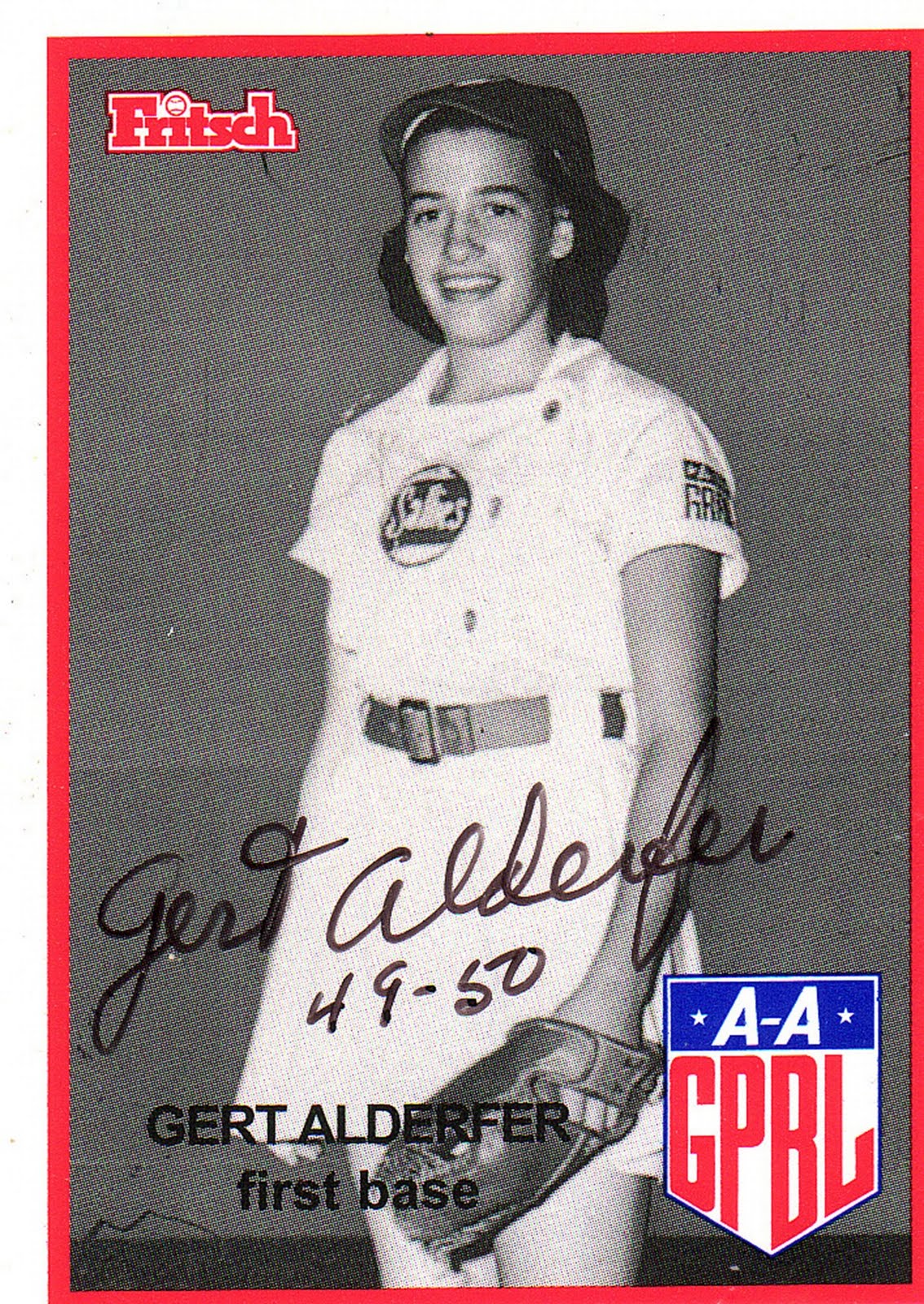
A League of Their Own and My Aunt Gert Alderfer

Every few months or so, the movie, "A League of Her Own," seems to be playing on all the late night channels. If you look closely enough at the end of the movie when the Women's Baseball Hall of Fame comes into the picture, you'll catch a glimpse of my aunt - Gert (Gertrude Alderfer) Benner. Although the movie depicts an earlier time in the history of the All American Girls Professional Baseball League, my aunt was very much a part of this history. For one summer in my youth, I was the leagues mascot.

The summer I turned nine, my family moved from Pennsylvania to Florida where my summers really did become endless. My favorite though was the short summer of my twelfth year when I was sent back to Pennsylvania to visit with my Aunt Gertie. Images of that summer flash through my mind and I remember the baseball games she took me to and the crowds of people running to get her autograph after the game ended - I didn't know why grown men, women, and children converged upon not just my aunt, but the other women as well.

And then I met boys - who informed me that my aunt was "the" Gertie Alderfer. As if I should have known who she was, which I did, obviously because she was my aunt. But then I realized that she was so much more.

[The photo on left is my aunt going in for a home run!]

That summer I visited aunt Gertie was my first indoctrination into the art of being a feminist, or a woman who walked the walk and spoke the talk. My mother and grandmother had been showing me in subtle ways all along. But it was my aunt Gertie broke barriers in an era when women were deemed unable to do more than just raise children and take care of the day-to-day life of running a household.

That summer I learned that my aunt Gertie was a celebrity in womens'  baseball (though technically it was called softball). The larger version of the ball was considered less dangerous. I didn’t realize that womens' professional baseball  was a big 'thing,' until long after the movie, A League of Their Own came out.

I was googling and typed in my maiden name - Alderfer -  then led to several sites on Ebay. I did a double take - a picture showing a much younger version of my aunt stared back at me. The ad attested to the validity of her signature on the baseball even though her trading card wasn’t made until a later date. The bidding was already at $300.00. I called my dad. “Did you know that Aunt Gertie is a celebrity?” I told him. “Her autographed balls are selling on Ebay.”

I knew my aunt's story because in many ways her story was also my story.Although I had only two brothers, with five brothers, my aunt took on every sport challenge they would include her in on and besides baseball she excelled at basketball and hockey. She could out run, out jump, out shoot, out pitch, and out throw any of her brothers and most of the males in her school. She has medals and trophies in numerous sports.

[The image on the right shows my aunt on the day of her wedding with my mother who was her matron of honor.]

July 20, 2010

Clint Miller . . . Lost Legacy and Dying Memories

Today's Winston-Salem Journal had a small blurb in the "Ask Sam" column, in regards to an old roadway near Miller Park and was actually a bowling lane installed in 1942 on land donated to the city of Winston-Salem by A. C. (Clinton) Miller. Clint as he was called, is the older brother of Ida Miller whose picture is posted in a previous post. There is another (older) brother, Frank Miller who was named after their father Frank Miller, and grandchildren of Harmon Miller, who was second in line after Robert Gray when the new city of Winston was founded as the county seat of Forsyth County in 1849. Harmon Miller's grandfather was Hermanus (Mueller) Miller, who traveled to North Carolina with Bishop Spangenberg in 1752 and established the Moravian settlements in Wachovia.

A. Clinton Miller was more than a prominent business man as the "Ask Sam's" column stated. Clint came from a quietly wealthy family. His father left in the neighborhood of $2,000,000 when he died in the early 1900s. All three children received a share and Clinton owned somewhere in the neighborhood of thirty properties in and around Salem as well as land in Florida, Oklahoma, and Texas. Prior to Charles Lindbergh's cross-country tour with a scheduled stop at Winston_Salem's Maynard Field in 1927, Miller donated $17,000 for the purchase of land to build a bigger field for the landing of Lindbergh and his Plane, "The Spirit of St Louis.

Even before Lindbergh's visit, Miller was known for his generosity and was a strong advocate of promoting sports in the area, having given money for the building of a professional baseball stadium on the South Side of Winston - this later became Ernie Shore Field.

But as in the case of Miller field being renamed Smith Reynold's Field for a young aviator son of R. J. Reynolds and who died at the age of twenty-one under "mysterious" circumstances. Then even Ernie Shore Field has been replaced, rather the home of baseball moved to the new Winston-Salem Dash stadium which is called BB&T Ballpark.

I think it comes down to --- he who has the bigger wallet wins and just about any place can be renamed (except for Lincoln's tomb and others so aptly named after the final resident).

In 1942, Miller donated 30 acres of land on the west side of Winston-Salem providing that the city would donate another 8 acres of land. Miller Street had already been named and since the land passed through the new park, the park was named Miller Park. So at least Miler Street and Miller Park are still in existence though it is doubtful that few people survive who remember the Miller family and their contribution to settling this area.

Clint never married and died in 1948. I have a letter dated the week before his death. I have letters he wrote as a young man off to school in New York and Boston. Letters from his travels, his investments, his family concerns, the stock market crash, letters to his sister Ida, his brother Frank before he died in 1933, and letters to his mother and father before their deaths.

My favorite letters are those that tell the story of youth and growing up, of weddings, births, and personal family matters which have turned me into a voyeur of life in a long ago bygone era of defiant grandeur, in the time when millionaires were made.

July 17, 2010

Things to do when it Rains Cats and Dogs in North Carolina on a Saturday . . .

Thunder rolled in early this morning and Zack and Zoie refused to let me sleep. Between wet kisses, anxious barking, cracks of lightning followed by loud thunder rumbling, the pups forced me into alertness. This was a pure ruse and underhanded tactics; the moment I got out of bed, Zack and Zoie climbed beneath the covers so my bed did not get made today. Besides my precious Yorkie puppies in training had already buried a dozen or more toys beneath the covers.

The cats were equally anxious and now there is a bit of a party going on upstairs of the shop. I hear thunder running down the halls, growls above my desk area, and definite hisses and yelps. The other humans have already left to attend to their typical Saturday routine, shopping, movie store, and the home improvement center.

Saturday mornings are usually quiet when I first open the shop, with the exclusion of noisy animals from above. Rain and gloomy skies tend to make the day drag by. Not so, I said to myself, not when my Benny Carter gourds hang above my head. Very few items are not for sale in my shop, and Benny's heads are two of them (actually Benny only has one real head).

I fell in love with Benny Carter and is Folk Art the same year I opened my antique shop. I've been an aficionado of Folk Art all my life and feel this venue has a place in the world of antiques and in decorations for the home. Eclectic is the word, and bon-a-fide conversational pieces.

I met Benny at an auction he had at his home just up the road a piece from me. I rate his auction as one of my all time favorites - I stayed until the very end, had to make several trips to haul off my goodies, and it was midnight before we were finally finished.

Even to this day people tell me about the pieces they bought and delight in at looking at every day. 
Benny Carter is quite famous now, his Folk Art work hangs in galleries and homes across the country. Although Folk Art is not for everyone's taste, it's fun to look at when it's raining cats and dogs on a Saturday and you have nothing else to do.

You are always welcome to Bethania, North Carolina, stop in and say hi, or just browse for a while and stay dry. 

I welcome small dogs, humans of all sizes and ages, and even frogs.

May the force of the frog be upon you. "Brekekekex koax koax!"

July 16, 2010

An Unwritten History of Winston and Salem . . . soon to be told . . .

From the vantage point of my desk and computer area in my shop, I can hear when cars pull in out of the drive. On one particular day soon after I newly opened for business, I heard a loud clanging and rambling of a motor, and saw a truck pulling garbage, or so I thought. I watched as a man got out and walked through my back door which was also an entry way at that time.

We talked for a while and then he asked if I would be interested in two old trunks he was hauling off to the junk yard. Of course I was curious and followed him to his truck. I liked the looks of them, though one was in pretty bad shape but both were steamer trunks and dated to the 19th century.

I looked inside and quickly shut the lid. "How much?"

I didn't bat an eye lash and handed him a check. He said to just throw away the old papers, they were on the way to the dump pile anyway and what ever I wanted to do with them, they were mine. 

The trunks sat in my back room for more than a week before I could go through the insides and sort through material. It took less then 60 seconds to realize that I had died and gone to heaven. I worked my way through dresses and gowns, an assortment of Victorian whites and under garments, children's clothing, blankets, vanity items, hair pieces and other oddities. The real treasures, at least to me were the endless yellowed envelopes, scrapbooks,photographs, cabinet cards, tin types, newspapers, booklets, and other paper items dating back to the Civil War.

It took me months and months to go through the material, to read every word, to become lost in history. Many of the letters are from mothers to daughters from the same family spanning almost 150 years. I was and still am over-whelmed with the material because I had stumbled upon a powerful story of families who rose to become scions, wealthy land owners, backers of almost every business which rose from the city that became Winston-Salem, North Carolina.

I am finally ready to write the story . . . When Society Reigned and the Making of Millionaires.

July 15, 2010

What metal was a sign of social status to the Victorians?

QUESTION:
I'm stuck on a question in my book about what metal was a sign of social status to the Victorians? I checked the internet, went to the library. And nothing is coming up. Only one little part about silver ...and I always thought it was silver, but I am confused because there is a line in my text book which reads...Britannia metal - This ware was made during Victorian times and was mass-produced in large quantities with the help of the large steam driven machines. Because of this sentence, I am really kind of lost. Can you help me sort my metal problem out? And where when I need to research something can I go , on the internet? I need a good source area or do I need a lot of reference books?

ANSWER:
This is a easy question - more or less - Britannia metal (also known as Vicker's white metal) was invented about 1770 and really did not become accepted until 1840 or around the beginning of the Victorian era. The metal is made from mostly tin, and a little antimony which is not really a metal and copper. Antimony gives it the appearance of silver and copper makes tin more durable or stronger - a little of both went a long way. Because this metal could be molded or poured into molds, the popularity jumped when utensils, vessels of all sorts hit the market so to speak - because they were first cheaper and then much easier to care for - less polishing then silver. The metal also has a similar look to pewter, in fact was an outgrowth of pewter though pewter also has zinc. Both metals darkens with age in a similar manner.

Britannia metal may also be called Sheffield, but you'll find items such as quadruple plate or Meridian wares that grew out of this material. Victorians liked having a specific utensil, bowl, plate, etc and so on for serving foods. Since good silver could not be massed produced because each silver item required a skill that machinery could not duplicate. Britannia metal could easily be mass produced, and subsequently became popular with the mass market.

The question though as to what metal was a sign of social status is ambiguous to me and I can see why it is confusing. Status symbols were and still are metals such as gold, silver, and platinum - keep in mind though that all of these were (and still are - high quality that is) in short supply and not affordable. However, if you consider the mass or entire Victorian market - then the answer would need to be that which was mass produced and the average household could afford - the introduction of Britannia metal made it available to the average consumer.

July 7, 2010

Victorian Images

I have collected Victorian era images for many years. They often come in boxes and sometimes wonderful old books. Rarely do they have the name of the person whose image is shown although the cabinet cards may have the name of the photographer and the location.
The images fuel my imagination so that the person becomes a character in the story I am writing. I also use them in my writing classes to spark students imagination and in character building.

Some of my favorite images are that of children. They are often posed seated in a too big chair or standing as if hanging in mid air. They wear clothing that is pristine, hair perfectly combed or curled, hats with feathers like their mothers, though boys, small ones that is, wore skirts and dresses too. I have one in my collection, of a child taken soon after its death. Funerary picture taken was not uncommon.

My collection of photographs comes from all over the country, world in fact. I used to have numerous Daguerreotypes, tin types, early glass negatives and stereo views, but this collection has dwindled.

Years ago, when I was a power seller on Ebay, and once sold old cameras and glass magic lantern slides for a consignor. Some of the images were identifiable, but many were not. I personally bought those that were left, thinking I would do something with them one day - until I found out how much it would cost to convert the glass image to a real picture. I showed them to several people I knew because the photographer was a local name. To my extreme delight, the images were of local people, places, and even things. I did have them reproduced and the images made a fabulous addition to my book, Bethania: The Village by the Black Walnut Bottom. Some of these can be viewed on my website along with modern day images taken by Bowman Gray IV. His photography is awesome and he is soon releasing a book by Blair Publishing - more on this later.

July 3, 2010

The Real Meaning of Frogs . . .


I've had this particular frog standing outside my antique shop since I opened in 1996. I cannot sell this frog because he reminds me of the Frog spirit "Ch'ing-Wa Sheng" and is associated with healing and good fortune in business. I could sell him almost every day but unfortunately they broke the mold. They - meaning the maker of the frog, rather the maker's mother who designed my frog, then got mad for some reason and killed the mold.

Frogs are very popular in many cultures, even play a role in the Bible; they are the second plague in Exodus and associated with unclean spirits in Revelations. Aristophanes wrote a play called "The Frogs" around 405 BC. A choir of frogs sings the famous line: "Brekekekex koax koax." Even the Modern Major-General from Gilbert and Sullivan's 1879 comic opera "The Pirates of Penzance" says; "I know the croaking chorus from "The Frogs" of Aristophanes! Brekekekex koax koax."  (God Bless you.) I think the chorus means "kiss me and I will turn into a handsome Prince and love you forever." Either this or Aristophanes thought saying Ribit was uncool.

The Frogs to the left and below are for sale. The one on the left is already tall and handsome, and obviously caring because he always has flowers in his hands. On the other hand there is a strong possibility that 'He' may be a 'She' and is Heget, the Egyptian Goddess of fertility. The legend goes that if you kissed her, or even accidentally brushed against her, be prepared to "become with child." It's highly recommended that you kiss her only once. Women who have kissed a frog, have been known to have multiple births.

Frogs also play an important role in science and the study of Biology. There used to be a time when you had to dissect a frog or flunk the course. Today parents can request a waiver simply by stating that their family is vegetarian and they only eat food grown from the earth. Frogs are green (supposedly) and subsequently saving frogs means "going green."

The frog server below is the perfect height for holding business cards or holding a can of beer. He looks a lot like Kermit the Frog but even more so, like Froggy the Gremlin from the Andy's Gang TV show of the1950s. Froggy was called the Gremlin because he was a troublemaker and always getting into trouble. He was a lot like me.

My favorite frog story is the one I heard today --- from one of my customers. She said that the word Frog stands for --- Forever Rely On God.  The story goes that a woman lay dying in a hospital and was visited by a lady with long blond hair wearing white. The two women spoke for a while, until the sick woman fell asleep. The lady left a small stone frog on the dying woman's bedside table. The next morning, the dying woman was sitting up in bed, miraculously showing no signs of her illness, when the nurse came in the room. The nurse saw the frog on the nightstand and said, "The Guardian Angel visited you last night, didn't she?" But the woman had no recollection of the vision, just a sense of peace, health, and love. 

Frogs can and often do, mean a miracle is present. Just kiss the statue and find out for yourself . . . .

July 2, 2010

Burried Treasures

A few years ago we decided to hook into the sewer line when it finally came to Bethania. Thankfully my husband is a plumber and saved us a great expense. Sort of because his buddy who had a dirt digger, managed to fracture one of those huge cast iron tiles that fed the run-over water into the creek at the back of our property. Of course this faux pas had to be replaced. The process took longer then planned.


I watched almost hourly as the dirt came out of the ground. My girls and I would jump on the mounds and sort through the debris. Shards of pottery were plentiful as were old rusted nails. We were rewarded on occasion with  several identifiable pieces such as these four early bottles. The small green bottle dates to the late 1700s and was most likely a medicine bottle.


This tattered piece of paper is really yellowed with age and was written by a doctor for a small patient around 1828. I found this along with many other amazing documents and letters inside a box destined for the trash heap.


I see this a lot and am often saddened to see someone's lifetime put up for sale at an auction or
estate sale. I have stacks of papers and images of people from the past. I can't bare to part with them because they also fuel my imagination and even play a major role in my writing and teaching. I take on their memories and their lifetime.


My students learn to place themselves inside the pictures. They learn to build stories based on other people's lives. They share dreams and learn to use all their senses in developing their own writing.


Back to the bottles and the doctor's orders. In the true sense of the cliche, one man's trash is another man's treasure, digging in dirt can be rewarding.

June 30, 2010

Why I am an Antique Junkie

First my maiden name begins with an A and is recognized in the Industry - Alderfer - a primo auction house located in Hatfield, Pennsylvania, which, also happens to be where my father resides. I am certain that we are related somewhere in my father's family's long history because he is a direct descendant of the first Alderfer to come to America in the 1600s. I happen to own a spinning wheel which made the trip although it is now a chair and one of ten known to exist in the world.